How we reviewed this: this is a research-based review. We did not buy or test the product ourselves. We checked the official website, policies and independent customer feedback, and every fact below links to its source. Facts checked 2026-10-31. How we review · Affiliate disclosure: we may earn a commission if you buy through our links, at no extra cost to you.
Quick verdict
Austin Air makes some of the best purifiers you can buy for smoke, odors and chemical fumes (VOCs), and some of the most expensive for everyday dust and pollen. Each full-size unit holds about 15 lbs of activated carbon and zeolite. HouseFresh, which bought and lab-tested the HealthMate, called that “the largest amount we have seen in a household air purifier” and said it is “the best air purifier on the market today if you have serious issues with VOCs or odors. Otherwise, you should look into cheaper units.”
The honest part: Austin publishes no CADR (clean air delivery rate) and no room size, and its own FAQ says “Austin Air is not AHAM/CADR-certified.” In HouseFresh’s smoke test, the $845 HealthMate cleared the room in 52 minutes, about the same as a $99 Levoit Core 300 (54 minutes) and twice as slow as a $240 Coway (26 minutes). In 2024 the EPA also issued Austin a formal Notice of Warning over how four models were marketed (no penalty).
Our picks: HealthMate Plus ($895) if your problem is wildfire smoke, chemical smells, new paint or furniture fumes. HealthMate ($845) for general odors, smoke and mold-season air. If you mainly want to cut dust and pollen, buy a cheaper HEPA purifier instead.
Pros
- ✓ About 15 lbs of carbon and zeolite: the most HouseFresh has seen in a home purifier
- ✓ Filters last about 5 years, so few replacements
- ✓ Built in Buffalo, NY since 1990; steel body, no ozone and no ionizer
- ✓ BBB A+ with only 1 complaint in 3 years; no CPSC recalls found
- ✓ 5-year mechanical warranty and a 30-day return window
Cons
- ✗ Expensive: $845 to $1,145 for full-size units; filters $395 to $695
- ✗ No published CADR or room size; not AHAM certified
- ✗ Particle cleaning was no faster than a $99 Levoit in HouseFresh’s test
- ✗ Heavy (47 lbs), loud at top speed (61.5 dB) and draws 148 W
- ✗ No sensor, auto mode or app; a filter change needs a screwdriver
- ✗ EPA Notice of Warning in 2024 over marketing of 4 models (no penalty)
See the HealthMate Plus on Austin Air →
Which Austin Air purifier should you buy?
| Model | Price (2026-10-31) | Austin says it’s for | Replacement filter |
|---|---|---|---|
| HealthMate | $845 | Everyday air, smoke, odors, mold season | $395 |
| HealthMate Plus | $895 | Chemicals, VOCs, formaldehyde, wildfire smoke, new or remodeled homes | $445 |
| Bedroom Machine | $995 | Bedrooms and chemical sensitivity | $545 |
| Immunity Machine | $1,145 | Austin markets it for “heightened immune vulnerability” | $695 |
| HealthMate Junior | $610 ($650 with wheels) | Smaller rooms (21 lbs) | $295 |
| HealthMate Plus Junior | $660 ($700 with wheels) | Smaller rooms, chemicals (21 lbs) | $345 |
Prices are from Austin Air’s US store on October 31, 2026. The older Allergy Machine and Pet Machine are no longer sold as units; only their replacement filters are still listed. We’d skip the Immunity Machine’s health claims (more on that below) and judge it on filtration alone.
HealthMate Plus: the pick for smoke and chemical fumes
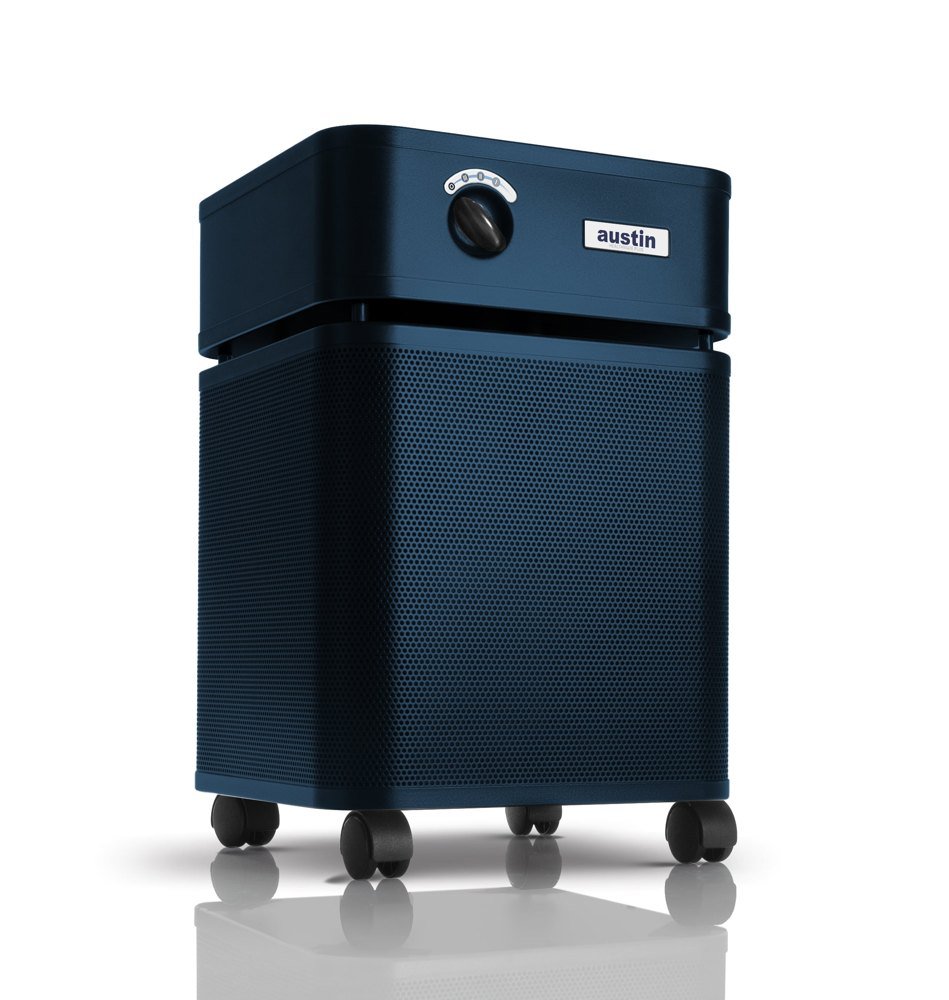
The HealthMate Plus uses the same 47-lb steel body, 360-degree intake and “medical grade” HEPA filter (rated 99.97% at 0.3 micron) as the HealthMate, but its carbon is blended with potassium iodide-impregnated carbon aimed at chemical gases like formaldehyde. Austin pitches it for wildfire smoke, new carpet and paint fumes, and remodeled homes. There’s no independent lab test of the full-size Plus yet, so the HealthMate test below is the best evidence for how the body and fan perform.
HealthMate: what independent testing found
HouseFresh bought a HealthMate with its own money and tested it in a 728-cubic-foot room using incense smoke and air sensors (published May 2023, updated February 2026).
- Particles: 52 minutes to clear PM1 at top speed (76 minutes on the quiet setting). For comparison: Coway AP-1512HH 26 minutes, IQAir HealthPro Plus 28, Alen BreatheSmart 45i 30, Levoit Core 300 54.
- Chemicals and odors: VOC readings “dropped substantially over several hours.” This is where the big carbon bed earns its price.
- Noise: 42.5, 53.2 and 61.5 dB on speeds 1, 2 and 3. “At 61.5 dBA, it gets pretty loud when running at top speed.”
- Power: 61, 85 and 148 watts. HouseFresh estimated about $164 a year in electricity running 24/7 on top speed.
- Verdict: “this device is overkill for those looking to keep dust and pollen levels low due to its high initial and running costs.”
See the HealthMate on Austin Air →
What it really costs over 5 years
Austin filters are designed to last about 5 years in normal use (sooner with pets, smoking, new carpet or paint fumes). There’s no filter indicator: you replace it when it starts to smell or airflow drops. Using HouseFresh’s electricity figures, a HealthMate costs roughly $1,185 to $2,060 over 5 years: $845 for the unit, $340 to $820 in electricity depending on fan speed, plus $395 if you buy a new filter in year 5. That’s our estimate, not Austin’s.
The “5-year filter warranty” is really a discount. If a filter wears out early, you get 40% off a new one in years 0 to 2, falling to 10% off in years 4 to 5. A HealthMate filter that dies in year 1 still costs you about $237.
The health claims, and the EPA warning
Austin’s site says its purifiers are “clinically proven” to help with asthma and respiratory health. Its own clinical trials page is more careful: it says “some of ours came back mixed,” that the Johns Hopkins CLEAN AIR trial “did not reach its primary endpoint when non-adherent participants were included,” and that “An air purifier is not a treatment and not a cure.” Austin also donated or discounted units for several of those studies.
In April 2024 the EPA closed a case (FIFRA-02-2024-5098) with a formal Notice of Warning to Austin Air for “selling and distributing misbranded pesticide devices”: the HealthMate, HealthMate Plus, Allergy Machine and Bedroom Machine. There was no penalty, and the record doesn’t say which claims were the problem. This kind of case usually involves claims about killing germs or viruses. Buy an Austin for what it filters, not for medical promises. If you have asthma or another condition, talk to your doctor.
Air purifier for mold: is Austin a good choice?
Austin markets the HealthMate for “mold/mycotoxins.” A HEPA filter can capture airborne mold spores, and the carbon helps with musty smells. But no purifier fixes mold growing in your home: you still need to find and fix the moisture source and clean or remove moldy materials (our guide do air purifiers help with mold? walks through what the EPA and CDC say to do first). If you’re buying for musty odors after the cleanup, the big carbon bed is a genuine strength.
Warranty, returns and shipping
- Warranty: 5-year mechanical warranty “under normal residential use,” but only if you register it. For a claim you get an RA number and ship the unit back insured with the original bill of sale.
- Returns: 30 days, in original condition and packaging, with a Return Authorization Number from returns@austinair.com. Austin gives “a refund, a replacement, or an exchange.” Replacement filters can’t be returned. The policy doesn’t say who pays return shipping on a 47-lb unit, so ask before you buy.
- Shipping: ships from Buffalo, NY, usually the same business day for orders by 1 PM Eastern. Austin’s FAQ says registering on its site gets you free shipping.
Austin Air vs other air purifiers
| Purifier | Price | CADR (smoke) | Filter cost |
|---|---|---|---|
| Austin Air HealthMate | $845 | Not published | $395 about every 5 years |
| Coway Airmega AP-1512HH | $239.99 | 233 | About $60 to $65 a year |
| Levoit Core 300-P | $84.99 to $104.99 | 143 (CADR) | $29.99 to $39.99 |
| Levoit Core 400S-P | $219.99 | 231 (CADR) | $59.99 to $64.99 |
| Blueair Blue Pure 211i Max | $349.99 | 435 | $69.99 to $89.99, up to 9 months |
| Alen BreatheSmart 45i | $449 to $479 | 255 (CADR) | $69 to $99, 6 to 12 months |
| IQAir HealthPro Plus | $1,199.99 | Not stated | HouseFresh est. about $200/yr |
For dust, pollen and pet dander, the cheaper purifiers above move more clean air per dollar. Austin’s edge is the sheer amount of carbon for gases and odors, long filter life, and a simple steel build with no ozone or ionizer. The Coway, for example, includes an ionizer (“Bipolar Device”) in its spec.
Who should buy an Austin Air
- Good fit: wildfire smoke, cigarette or cooking smoke, chemical smells from new paint, carpet or furniture, and people sensitive to odors who want a no-ozone, no-app machine that runs for years.
- Skip it if: you mainly want less dust and pollen, you need a quiet bedroom unit on high, or you want smart features. A $100 to $350 HEPA purifier will do that job as well for far less.
See Austin Air’s current prices →
FAQ
Is Austin Air worth the money?
For smoke, odors and chemical fumes, yes: its roughly 15 lbs of carbon is the most HouseFresh has seen in a home purifier, and filters last about 5 years. For dust and pollen alone, no: HouseFresh found the $845 HealthMate cleared particles about as fast as a $99 Levoit Core 300.
What is the difference between the HealthMate and HealthMate Plus?
Both use the same 47-lb body, HEPA filter and about 15 lbs of carbon. The HealthMate Plus ($895) adds potassium iodide-impregnated carbon aimed at chemical gases like formaldehyde, so Austin recommends it for VOCs, new or remodeled homes and wildfire smoke. The HealthMate ($845) is the everyday model.
How big a room does an Austin Air cover?
Austin doesn’t publish a room size or CADR and says it is not AHAM/CADR-certified. In HouseFresh’s 728-cubic-foot test room, the HealthMate took 52 minutes to clear smoke particles at top speed.
How often do you change an Austin Air filter?
About every 5 years in normal use, sooner with pets, smoking, new carpet or paint fumes. There’s no filter indicator; replace it when it smells or airflow drops. Replacement filters cost $395 (HealthMate) to $695 (Immunity Machine).
Does Austin Air produce ozone?
No. Austin says its purifiers produce no ozone and use no ionizer, which is a plus over some cheaper purifiers that include ionizers.
Is an Austin Air good for mold?
Its HEPA filter can capture airborne mold spores and the carbon helps with musty smells, and Austin markets the HealthMate for mold. But a purifier doesn’t fix mold growing in your home; you still need to fix the moisture source and clean up the mold.
Where are Austin Air purifiers made?
Austin Air Systems says its purifiers are handcrafted in Buffalo, New York, where the company has operated since 1990.
What is Austin Air’s return policy?
30 days from receipt, in original condition and packaging, with a Return Authorization Number. Austin offers a refund, replacement or exchange. Replacement filters can’t be returned, and the policy doesn’t say who pays return shipping.
Sources
- Austin Air HealthMate (official)
- Austin Air HealthMate Plus (official)
- Austin Air purifiers (all models)
- Austin Air replacement filters
- Austin Air FAQ
- Austin Air 5-year warranty
- Austin Air refund policy
- Austin Air shipping policy
- HouseFresh: Austin Air HealthMate review and test
- EPA ECHO case 02-2024-5098
- BBB: Austin Air Systems
- Coway Airmega AP-1512HH
- Levoit Core 300-P
- Levoit Core 400S-P